
Refind Realty Blog
Why Red Oak foundation cracks show up in August — and what sellers should do before listing
Why Red Oak foundation cracks show up in August — and what sellers should do before listing
By Steven J. Thomas
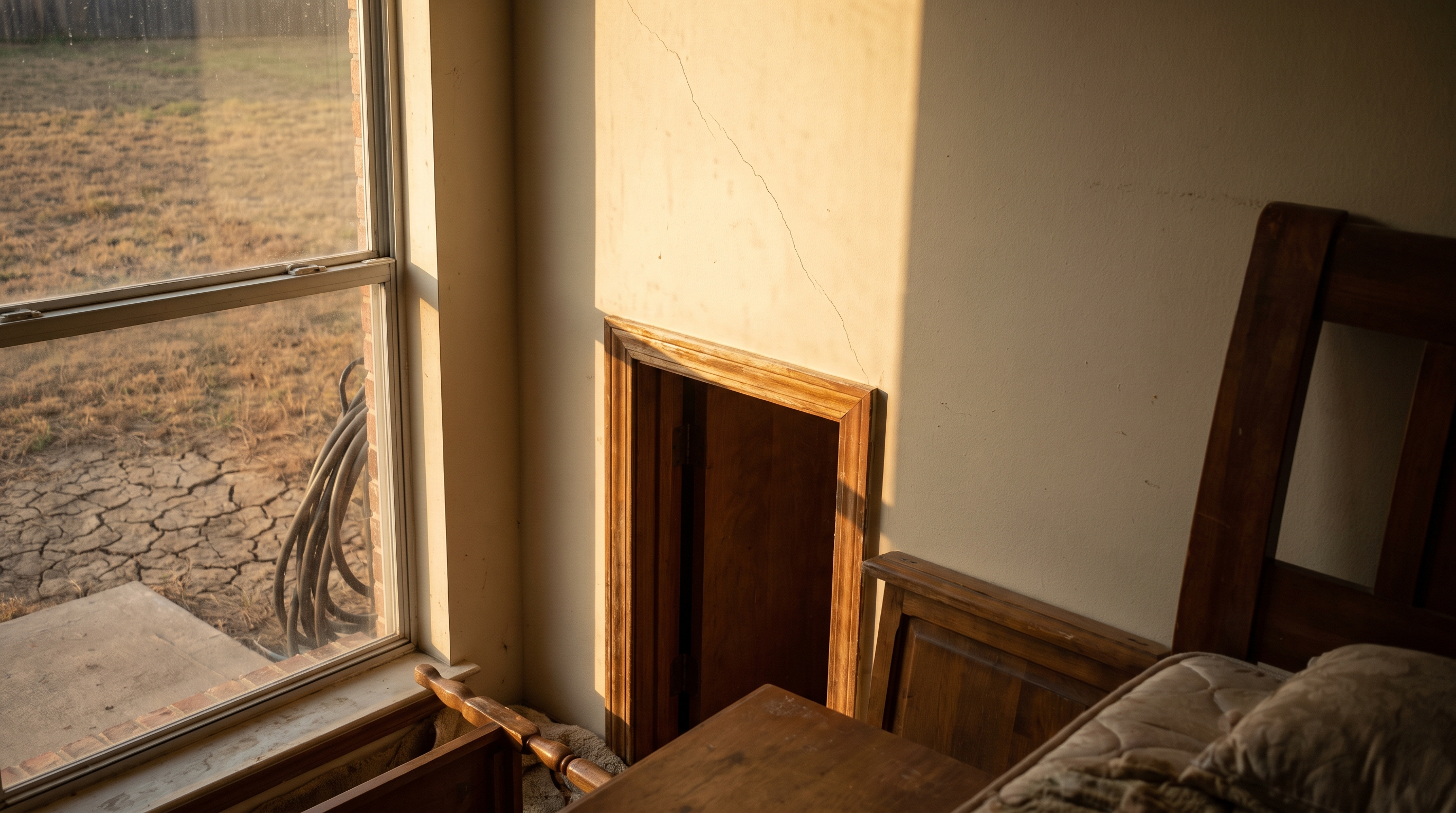
You walk down the hall in mid-August and the guest room door won't latch anymore. A week later there's a hairline crack angling up from the corner of that same door frame. If you own a home in Red Oak and you're planning to list this fall, that little crack is now the most expensive thing in your house — not because of what it is, but because of what a buyer's inspector is going to write about it in thirty days.
The short answer
In Red Oak and across Ellis County, a late-summer crack is usually a soil moisture story, not automatically a structural one. Expansive clay shrinks as it dries out, the perimeter of the slab moves, and doors stick while sheetrock splits at the corners. Sellers who document the condition before listing keep control of the negotiation. Sellers who let a buyer discover it during the option period hand that control away.
Most agents look at the house. The full picture is the soil under it, the lender behind the buyer, and the paperwork sitting in between. I want to walk you through all three, because in August those three things decide whether your deal survives inspection.
Why the cracks show up in August and not in April
The ground under Red Oak, Glenn Heights, Waxahachie, and most of southern Dallas County is expansive clay. It is not inert dirt. It behaves more like a sponge. When spring rain soaks it, the clay swells and lifts. When a Texas summer bakes the moisture out of it, the clay shrinks and pulls back, and it does not shrink evenly. The soil at the perimeter of your slab dries out first because it is exposed on all sides. The soil under the center of the house is shaded by the slab itself and holds moisture longer.
So by the second week of August, the edges of the house have less support than the middle. That differential is what you feel in your doors and see in your walls. The classic late-summer symptom list in Ellis County looks like this:
- Interior doors that latched fine in May and now stick at the top corner or drag on the jamb
- Hairline sheetrock cracks running diagonally off the upper corners of door and window openings
- Mortar joints separating slightly where brick meets the garage door frame or a corner
- Nail pops in ceilings and along wall studs
- A gap opening between the soil and the exposed edge of the slab, wide enough to slide a ruler into
None of that tells you your foundation failed. It also does not tell you it didn't. I am not going to diagnose your house in a blog post, and neither should anyone else who has not been inside it. What I can tell you is that this pattern shows up every year in this corridor when the soil dries out, and it shows up on a schedule that lines up with the exact weeks people want to list before fall.
What the soil is doing right now
Based on current conditions, the drying pressure is real but not extreme. Here is where Texas stood in the first week of August 2026:
- Roughly 25 percent of Texas is in active drought, with another 24 percent rated abnormally dry — Source: U.S. Drought Monitor, August 4–8, 2026
- Drought coverage has contracted across North and Central Texas, and Extreme Drought (D3) has been removed from the region — Source: U.S. Drought Monitor, August 2026
- The seasonal outlook favors persistence where drought remains, with above-normal temperatures and little indication of beneficial summer rainfall — Source: drought.gov, August 2026
Read that the way a soil scientist would read it. Conditions improved enough that we are not in a punishing drought year, and they are still dry enough, and hot enough, that clay is going to keep giving up moisture through the rest of the summer. The forecast does not promise you a rain event that resets the ground before your listing photos. Plan as if the soil keeps shrinking for a few more weeks, because that is what the outlook says.
Seasonal movement versus a real structural problem
Here is the distinction that actually matters, and I want to be careful with it, because I am a broker and a loan officer, not an engineer.
Seasonal movement tends to be reversible. The house moves a little as the soil dries, and it moves back as moisture returns. The cracks are thin, they stay about the same width, and the door that stuck in August often behaves itself again in November. Homes in Ellis County have been doing this since they were built.
Structural distress is a different animal. The signs that make an engineer sit up are things like cracks that keep widening week over week, separation you can see daylight through, brick cracks that step diagonally across several courses, doors and windows visibly out of square, floors measurably out of level, or a slab edge that has dropped away from the wall above it. Any one of those means you stop guessing and hire someone with a license and a seal.
The honest answer is that you cannot sort this out by looking at a photo, and neither can the buyer. That is exactly why documentation is worth so much in August. An engineer's report converts an argument into a fact.
What you can actually do to the soil before you list
You cannot control the weather. You can control how fast the ground under your house changes, and consistency is the whole point. Here is what I tell sellers in Red Oak when they call me in August.
Water the perimeter on a schedule, not on a panic
Run a soaker hose set back roughly 12 to 18 inches from the slab, not pressed against it. You are trying to keep a moisture band steady, not saturate the soil against the foundation. Short cycles on a timer, several days a week, early morning, beats one long flood after a dry stretch. Flooding dry clay is the worst thing you can do to it, because a fast swell after a deep shrink is a bigger swing than the shrink was.
Fix the water you already have
Gutters full of last fall's leaves dump rainwater in one spot at the corner of the house. Downspouts that end six inches from the slab put every bit of roof runoff exactly where you least want it. Extend them out several feet and make sure the grade actually falls away from the house. Free to check, cheap to fix, and it is the first thing a good inspector looks at.
Think about the trees
A mature tree pulls a serious amount of water out of the ground every day in August, and the roots reach roughly as far as the canopy does. If a large tree sits close to the house, that is a conversation to have with an arborist and, if it comes to it, an engineer. Root barriers exist. Also, do not take down a big tree three weeks before listing on a whim — removing a tree changes the moisture balance too, just in the other direction.
Two things I will not tell you. Watering will not close an existing crack. And nothing here comes with a promise about how your specific home responds. This is about slowing the swing and being able to show a buyer that you were paying attention.
The paperwork that keeps a deal alive
This is the part most sellers skip, and it is the part that decides the outcome. Based on current conditions and the quotes I see Texas sellers receive on this work, here is what the documentation typically runs:
- Structural engineer's evaluation: roughly $300 to $800 in Texas. A licensed professional engineer walks the home, takes elevation readings, and writes an opinion about what is happening and whether anything needs to be done.
- Final certification or engineering report after repair: roughly $200 to $500. This is the letter that says the work was done and the engineer signed off on it.
- Transferable warranty documentation: if a prior owner or you had piers installed, find the paperwork. Most reputable foundation contractors issue a lifetime transferable warranty. It is worth real money to a buyer, and it is worth nothing if nobody can find it.
One rule about who you hire. Hire the engineer yourself and pay the engineer yourself. Do not accept the free evaluation from the engineer the repair company sends over. That report is going to be read by a buyer, a buyer's agent, an appraiser, and an underwriter, and every one of them knows the difference between an independent opinion and an opinion written by someone whose referral source sells piers. An independent report costs a few hundred dollars and carries several thousand dollars of credibility.
Get the report before the sign goes in the yard. Put it in the listing file with the watering records, the gutter work, any prior repair invoices, and the warranty. When a buyer's inspector flags a crack — and one will — you hand over a document that was written before you had a reason to spin it.
What repair costs look like if it comes to that
Sometimes the engineer says the house needs work. Based on current conditions and the quotes I see Texas homeowners receive, the ranges look like this:
- Average Texas foundation repair: commonly quoted in the neighborhood of $12,000
- Slab pier work: commonly $8,000 to $25,000 depending on pier count, pier type, and access
- Pier-and-beam repair: commonly $6,000 to $15,000
- Larger multi-pier work or whole-house leveling: commonly $15,000 to $30,000
Those are ranges, not quotes, and your number depends on soil, pier depth, the number of piers, and how hard it is to get equipment around your house. I am not going to guess at your figure and neither should a contractor who has not been out there.
Here is the math that matters. An engineer's report runs a few hundred dollars. A buyer who discovers an undocumented crack on day four of the option period does not negotiate against a repair estimate. They negotiate against their own worst-case number, and their worst-case number is usually the top of that range. I have seen the gap between those two positions run into five figures, on a home where the actual scope was a fraction of it.
How a foundation crack looks to the buyer's lender
This is where wearing both hats changes what I see. I am a broker at Refind Realty DFW and a loan officer, NMLS #689220, which means I have watched the same engineer's letter land on a buyer's kitchen table and on an underwriter's desk. Those are two very different rooms.
Conventional, FHA, and VA buyers generally cannot close on a home with significant unresolved foundation issues. When an appraiser notes structural concerns, the appraisal typically comes back subject to repair or subject to a satisfactory engineer's report. At that point the file stops. It does not matter how much the buyer loves the house or how motivated you are. Underwriting needs a document, and the document has to come from a licensed engineer.
So the practical question is not whether you eventually produce an engineer's report. If your home has visible movement, you are producing one either way. The question is whether you produce it in early August on your own schedule, or in late September under a deadline, while a buyer's lender holds your closing date and your next purchase hangs on it.
"An engineer's letter is not a marketing document. It is the piece of paper that lets an underwriter clear a condition. Getting it before you list means you are handing over an answer instead of asking a buyer to wait for one." — Steven J. Thomas, Broker at Refind Realty DFW and Loan Officer at Envision Home Lenders
What Texas disclosure asks of you
Say it plainly. Known material defects and prior repairs belong on the seller's disclosure. If you know about the crack, it goes on the form. If a prior owner had piers installed and you have the invoice, that goes on the form. If you had an engineer out last spring, that goes on the form.
I am not giving you legal advice here, and this post is not a substitute for it. What I will tell you is that this belongs on your disclosure, and your agent and your title company will walk you through the form line by line so nothing gets missed. The Texas Real Estate Commission publishes the notice, and every listing I take goes through it carefully.
A point sellers miss. Disclosing a documented, evaluated condition is a much stronger position than disclosing a vague one. "Hairline crack at hall door, evaluated by a licensed PE on August 12, 2026, report attached, no repair recommended" reads completely differently than "some cracking, unknown cause." Same house. Different deal.
Why an undocumented crack costs more in this market than it did two years ago
Buyers have options right now, and options change behavior. Based on current conditions:
- Roughly 4 in 10 active DFW listings are carrying a price reduction — Source: reported DFW metroplex listing data, 2026
- The median seller price cut runs about $15,000, or roughly 3.6 percent — Source: reported DFW metroplex listing data, 2026
- Texas median days on market sat at about 64 days as of May 2026 — Source: Texas A&M Real Estate Research Center
- Texas is running roughly a 5.3-month supply of homes — Source: Texas A&M Real Estate Research Center, 2026
Five months of supply is a balanced-to-buyer-friendly market. When four in ten sellers around you have already cut, a buyer sitting on a foundation question does not feel any pressure to work it out with you. They ask for a five-figure credit, or they terminate and go look at the next house on their list Saturday morning. You can follow the broader numbers on the DFW market statistics page, and they point the same direction.
Here is a composite, stitched together from several Red Oak and Waxahachie conversations rather than any one home. A couple lists in September after ten years in the house. An inspector notes a quarter-inch crack at the garage corner and writes "recommend evaluation by a structural engineer." The buyer's agent asks for $18,000. The sellers scramble, get an engineer out in six days, and the report says seasonal movement with no repair recommended. The buyer stays, but the sellers have already given up $6,000 to keep them at the table and lost two weeks off their build timeline. That report cost $500 and would have prevented the entire conversation if it had been in the file on day one.
What to do in the next thirty days
If you are listing this fall in Red Oak, Glenn Heights, Waxahachie, or anywhere along the southwest DFW corridor, here is the order I would work in.
- Walk the house this week. Photograph every crack with a coin or tape measure in the frame and write the date on the photo.
- Set up perimeter watering on a timer now, and write down the schedule. That log becomes part of your file.
- Clean the gutters, extend the downspouts, and check that the grade falls away from the slab.
- Hire an independent structural engineer directly. Budget $300 to $800 and plan on a report within a week or two, depending on scheduling.
- Hunt down any prior repair invoices and the transferable warranty before you list, not after an inspector asks.
- Sit down with your agent and go through the seller's disclosure with the report in front of you.
If the report recommends work, you then get to make a real decision instead of a rushed one. Repair before listing and sell with a certification letter, or price the home with the report attached and let buyers bid with full information. Both are legitimate strategies, and which one fits depends on your timeline, your equity, and what you are buying next. That is a planning conversation, and it goes better in August than in October.
Before you list
A crack that appears in August in Ellis County clay is usually the soil talking, not the structure. But nobody gets to decide that after the fact, when you are out in the driveway with a buyer's inspector and a $20,000 repair estimate somebody pulled off the internet. You decide it now, while the house is still yours and the only deadline is one you set. An independent engineer's report, a watering log, gutters that work, and a disclosure you can defend — that is a few hundred dollars and about two weeks. It is also the difference between a buyer who reads a document and a buyer who imagines a number.
Before we put a price on your house, I want to walk through it with you. The Home Selling Score is a free 30-minute in-person walk-through where I look at the whole home, including the things August is doing to it, and give you an honest readiness score before you list. Get your Home Selling Score at stevenjthomas.com/get-your-home-selling-score.
Key takeaways
- Late-summer cracks in Red Oak are usually driven by expansive clay shrinking as soil moisture drops, and only an engineer can tell you whether yours is more than that.
- Based on current conditions, roughly 25 percent of Texas is in drought with another 24 percent abnormally dry, and the outlook favors continued dryness with above-normal temperatures.
- An independent structural engineer's evaluation runs roughly $300 to $800 in Texas, and a final certification report runs roughly $200 to $500 — hire the engineer yourself, not the repair company's.
- Conventional, FHA, and VA buyers generally cannot close on a home with significant unresolved foundation issues without repair or an engineer's certification, so the report gets written either way.
- With roughly 4 in 10 active DFW listings already carrying a price reduction and a median cut near $15,000, an undocumented crack invites a renegotiation you did not budget for.
FAQ: Red Oak foundation cracks and selling your home
Should I get a structural engineer before I list my Red Oak home?
If you have visible cracks, sticking doors, or separation at brick joints, yes. Hire an independent licensed professional engineer, pay for the report yourself, and have it in the listing file before the first showing. It typically costs $300 to $800 in Texas.
Does a foundation crack lower my home's value?
An undocumented crack costs more than a documented one. Based on current conditions, average Texas foundation repair is commonly quoted in the neighborhood of $12,000, and buyers who find a crack without a report usually negotiate against the top of the range rather than the actual scope.
What happens if the buyer's inspector finds a crack during the option period?
Expect a request for a structural evaluation, a repair credit, or both, and expect it on a short clock. If the buyer is financed, the appraisal may also come back subject to repair, which stops the loan file until a licensed engineer signs off.
Is foundation movement worse in Ellis County than in other parts of DFW?
Ellis County and southern Dallas County sit on expansive clay soils that shrink and swell more than sandier soils elsewhere in the Metroplex. That is why Red Oak, Glenn Heights, and Waxahachie homes tend to show the same seasonal symptoms in the same late-summer weeks.
How long does it take to get an engineer's report and repairs done before listing?
Plan on one to two weeks for an engineer to inspect and deliver a written report, based on typical scheduling. If repairs are recommended, most residential pier jobs take a few days on site, with the final certification letter following after that.
Should I repair the foundation before listing or price it into the home?
Both work, and the right answer depends on your timeline, your equity, and what you are buying next. Repairing with a transferable warranty and a certification letter widens your buyer pool because financed buyers can close, while pricing it in with the engineer's report attached moves faster but narrows who can qualify.
Steven J. Thomas is a licensed Texas real estate broker at Refind Realty DFW and a loan officer at Envision Home Lenders, NMLS #689220, based in DeSoto, TX. 972-846-9170. This article is general information about market and soil conditions in southwest DFW and is not legal, engineering, or structural advice, and it is not a guarantee of any price, timeline, or outcome. Consult a licensed professional engineer about your specific property. Refind Realty DFW. Equal Housing Opportunity.

BLOG NAVIGATION
Contact Me By Filling Out
The Form Below
We Can Help You Reach Your Real Estate Goals!
Locate Us
Site: www.stevenjthomas.com
Call :(972) 846-9170
Email: [email protected]
Office 128 S. Cockrell Hill Rd, DeSoto TX 75115
Owned and Operated by Thomas & Thomas Financial Group, LLC
© Copyright 2026 | All Rights Reserved
Steven J. Thomas, REALTOR® · TREC License #0657467
Privacy Policy | Terms of Service | Fair Housing Statement
Refind Realty DFW · 128 S. Cockrell Hill Rd, DeSoto, TX 75115 · (972) 846-9170
Facebook
Instagram
X
LinkedIn
Youtube
TikTok