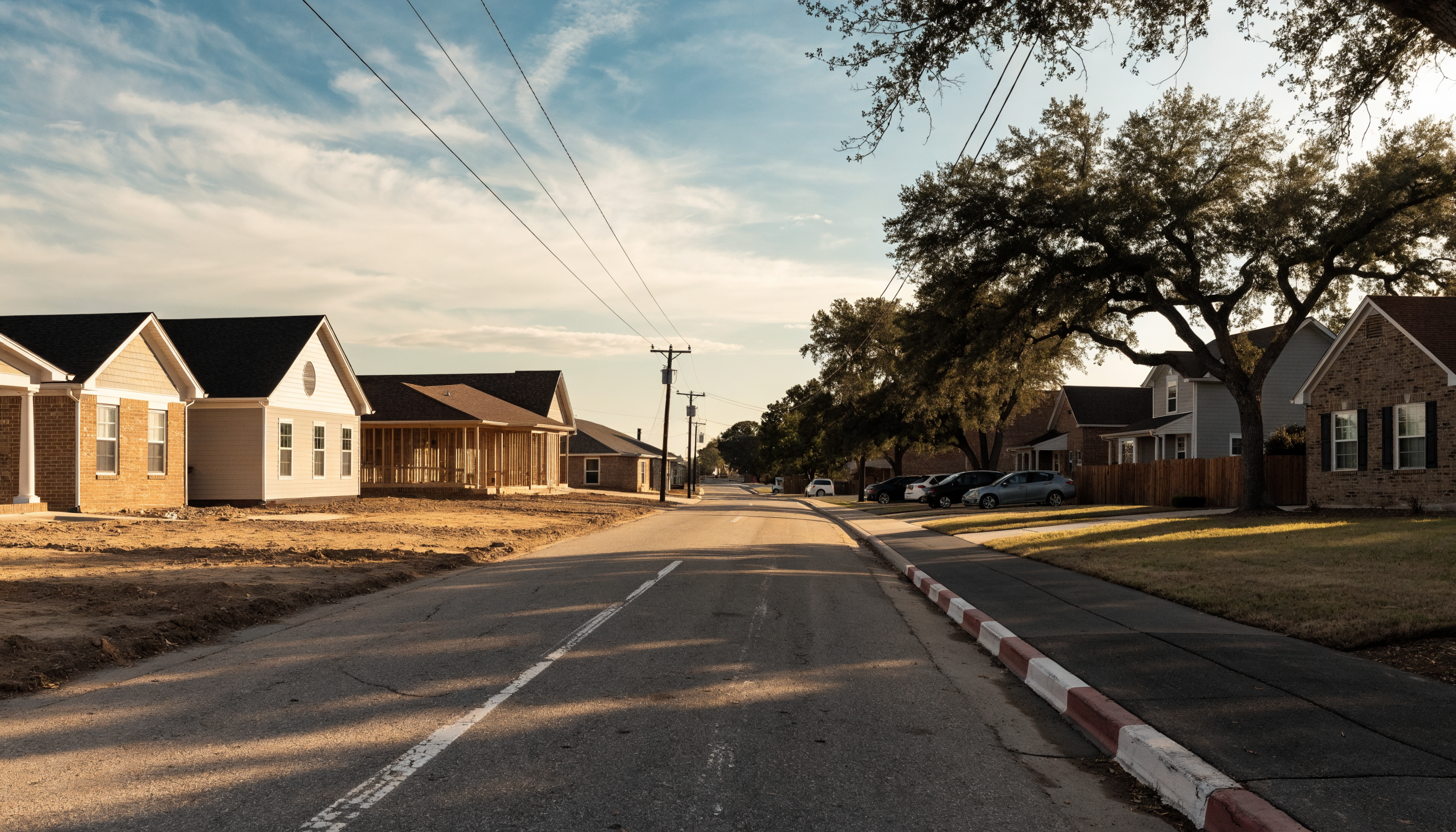
Mansfield New Build vs Resale: The Real Monthly Gap in 2026
By Steven J. Thomas
If you have shopped Mansfield this fall, you have probably noticed something odd. The brand-new spec home two blocks over is priced within a few thousand dollars of the fifteen-year-old resale on the established street. That is not a fluke and it is not a mistake in the listing. The National Association of Realtors reported in 2026 that the price gap between new and existing homes is the narrowest on record, and in some DFW submarkets resale homes are actually asking more than new. For a Mansfield move-up buyer, that changes the math on both sides of the decision, and it changes what you should be looking at when you walk into a model home.
The short answer
Based on current conditions, new construction in DFW runs roughly 5 to 10 percent above resale, and that spread is the tightest it has ever been. But the sticker price is only part of the story. Once you add a higher first-year tax assessment, a PID or MUD line, HOA dues, and the fence, blinds, and landscaping a builder does not include, a Mansfield new build can cost meaningfully more per month than a resale that looked $30,000 more expensive on paper. Compare monthly totals, not list prices.
Nobody in that model home works for you
Here is the part most buyers learn too late. The person who greets you at the model, walks you through the floor plan, and hands you the incentive sheet is a builder sales representative. That rep is paid by the builder and owes their fiduciary duty to the builder. They are not required to tell you the lot next door is going to be a lift station, that the community sits inside a Public Improvement District, or that the tax figure printed on the payment worksheet is based on a vacant-lot assessment that will roughly double next year.
Nobody in that building works for the buyer unless the buyer brings their own agent. And here is the number that makes it strange that anyone shops without one: in the side-by-side below, the monthly gap between a $385,000 Mansfield resale and a $415,000 Mansfield new build works out to about $311 a month, or roughly $18,660 over five years, and none of that comes from the price difference alone. It comes from the line items nobody in the model home is paid to bring up. Meanwhile, most DFW builders continue to pay buyer-agent compensation out of their marketing budget, which means the representation that would have flagged those line items is typically already priced into the home whether you use it or not.
One rule to write down: register your agent on your first visit. Since the 2024 industry rule changes, buyer-agent compensation is confirmed in writing rather than assumed, and many builder policies require the agent to be present or registered on that first visit for the builder contribution to apply. If you tour alone on a Saturday and bring an agent back on Tuesday, some builders will decline. That is a policy problem, not a legal one, and it costs you nothing to avoid it.
Mansfield and the southwest DFW corridor right now
Numbers first, all based on current conditions and all subject to change.
- DFW resale median: around $367,000, with resale homes closing in roughly 30 days (Source: GreySq, September 2026)
- DFW new construction: roughly $385,000 to $405,000, about 5 to 10 percent above resale, before any design-center upgrades (Source: GreySq, September 2026)
- Seller concessions: about 49 percent of DFW transactions in 2026 include some form of seller concession (Source: GreySq, September 2026)
- DFW median asking price: about $425,000 in August 2026, down 1.2 percent year over year (Source: Realtor.com, August 2026)
- Price reductions: 27.5 percent of DFW listings took a price cut in August 2026, against 20.4 percent nationally (Source: Realtor.com, August 2026)
- Days on market: the typical DFW listing sat about 58 days in August 2026, with roughly 29,549 active listings, down 4.4 percent year over year (Source: Realtor.com, August 2026)
- Dallas metro competitiveness: "somewhat competitive," about 2 offers per home, around 45 days to sell, median $475,000, up 2.1 percent year over year, with Fort Worth around $340,000 and 46 days (Source: Redfin, August 2026)
- Statewide supply: 5.4 months of inventory in Texas and an average 65 days on market in Q2 2026 (Source: Texas Real Estate Research Center, Q2 2026)
- Mortgage rate: the 30-year fixed averaged 6.71 percent as of September 3, 2026, up from 6.66 percent a week earlier and 6.50 percent a year earlier (Source: Freddie Mac Primary Mortgage Market Survey)
Now the local read. Homes in Mansfield are moving in roughly 50 days. Push south and west into Midlothian and Waxahachie and that number stretches toward 80. That difference is where the negotiating room lives. A builder carrying finished inventory in an 80-day submarket has a very different appetite for concessions than a builder selling out of a 50-day one. Mansfield sits at the tighter end of the corridor, which means you should expect the incentive conversation to be about rate buydowns and closing costs rather than deep price cuts, while a Midlothian or Waxahachie spec sitting 80 days may have both on the table.
That 27.5 percent price-reduction figure matters for a different reason. Nearly three out of ten DFW sellers cut their price in August. Resale sellers in Mansfield are watching the same slow-moving inventory the builders are. If you are only shopping new because you assume resale sellers will not move, you are leaving room on the table.
The side-by-side: $385,000 resale against a $415,000 new build
This is the comparison most buyers never actually run. Two homes, same city, roughly the same square footage, $30,000 apart on the sticker. Here is what they look like as monthly payments.
The assumptions, stated plainly
- Rate: 6.71 percent, 30-year fixed, per the Freddie Mac PMMS reading of September 3, 2026. The same rate is applied to both homes so the comparison isolates the property, not the loan.
- Down payment: 20 percent on both, which is realistic for a move-up buyer using equity and keeps mortgage insurance out of the comparison on both sides.
- Property taxes: an effective 1.67 percent of market value, which is the Tarrant County side of Mansfield after the $140,000 school homestead exemption, per Tarrant County rate data for 2025 and 2026. Mansfield also extends into Ellis and Johnson counties, where the effective rate runs higher, so verify which county a given address sits in.
- Insurance: $4,900 per year on the resale and $4,300 on the new build. Texas averages roughly $4,900 annually on a home in this price range per NerdWallet's 2026 rate data, and carriers commonly price a new roof and new wiring lower.
- HOA: $420 per year on the older street, $900 per year in the newer community.
- PID: $1,500 per year on the new build. Many newer Mansfield communities with trails, parks, and built-out entry features sit inside a Public Improvement District. Assessments are set by lot size and property type and can run 20 to 40 years.
| Line item | Resale at $385,000 | New build at $415,000 |
|---|---|---|
| Down payment (20%) | $77,000 | $83,000 |
| Loan amount | $308,000 | $332,000 |
| Principal and interest at 6.71% | $1,990 | $2,145 |
| Property taxes at 1.67% | $536 | $578 |
| Homeowners insurance | $408 | $358 |
| HOA dues | $35 | $75 |
| PID assessment | $0 | $125 |
| Estimated monthly total | $2,969 | $3,280 |
These figures are an illustration based on current conditions, not a loan estimate, a quote, or an offer of credit. Your rate, taxes, insurance, HOA, and any PID or MUD assessment will differ by address, credit profile, carrier, and county.
The gap is $311 a month. On a $30,000 sticker difference, principal and interest only accounts for $155 of it. The other $156 comes from taxes, HOA, and the PID line. Over five years that is about $18,660, and it never appears anywhere on the builder's brochure. Notice too that the new build actually wins on insurance, by about $50 a month, because a new roof prices better. Both directions are real. The point is that you cannot know which way a specific home breaks until you total it.
The costs that never make it onto the sticker
Everything below is a category of cost, not a prediction about any particular community. Verify each one for the specific address before you sign.
- The first-year tax assessment. This is the single most common surprise. If the appraisal district valued the property as a vacant lot or a partially built home on January 1, the tax figure on your payment worksheet reflects dirt, not a finished house. The following year the assessment catches up to the completed value and the escrow account comes up short. You then owe the shortfall plus a higher ongoing payment. Ask the builder's lender to underwrite the escrow on the completed value, and ask in writing.
- PID or MUD assessments. A PID assessment shows up as a separate line on your annual tax bill and can run for decades. A MUD district works similarly and typically appears as an added tax rate. Either can add hundreds of dollars a month depending on lot size. Get the assessment schedule and the payoff amount in writing, and ask whether it can be paid off at closing.
- HOA dues and transfer fees. Newer communities with amenity centers, trails, and maintained entry features carry higher dues than an established street. Ask for the current dues, the increase history, and the capitalization or transfer fee due at closing.
- Fence, blinds, gutters, and landscaping. Many base-level spec homes come without some combination of these. The resale on the established street has all of them, plus mature trees. Price the difference before you compare.
- Design-center upgrades. On a spec home already under construction, most of these decisions were made for you, which is either a savings or a compromise depending on the finish level. On a to-be-built, the design center is where the 5 to 10 percent premium quietly becomes 15 or 20. Set a written upgrade budget before your appointment.
- Appliances and window coverings. Refrigerators are often excluded. Washers and dryers almost always are.
- Lot premium. Greenbelt, corner, and cul-de-sac lots carry a premium that is folded into the price and rarely broken out unless you ask.
Run the same exercise on the resale. That home has its own list: roof age, HVAC age, water heater age, foundation and drainage history, and whether the electrical panel is one of the brands insurers have grown picky about. A fifteen-year-old roof is a $15,000 to $25,000 item on a Mansfield-sized home, and it is worth as much attention as any PID line.
How to compare a spec home to a resale on the same street
Six steps. Do them in this order.
- Get both total monthly payments in writing before you fall in love with either. Principal, interest, taxes, insurance, HOA, PID or MUD. One page, same rate, same down payment. If a number is an estimate, label it as an estimate.
- Verify the tax basis on the new build. Ask the appraisal district what the property was assessed at on January 1 and what a comparable completed home in the same section is assessed at now. Use the second number.
- Ask for the PID and HOA documents before you write the offer, not during the option period. If the builder cannot produce an assessment schedule quickly, that is information too.
- Price the move-in gap. Fence, blinds, gutters, sod, trees, refrigerator, washer, dryer. Total it. Then total the resale's deferred maintenance the same way, using the inspection.
- Compare the incentive to a price cut in dollars, not in adjectives. A rate buydown that saves $215 a month is worth roughly $2,580 a year. A $10,000 price reduction on the same loan saves about $52 a month. Depending on how long you plan to hold the home, either can be the better deal. Do the arithmetic instead of taking the sheet at face value.
- Have an independent inspection on the new build. New does not mean inspected on your behalf. Get a pre-drywall inspection if the home is still framing, and a final one before closing regardless.
What builder incentives are actually worth
Builder incentives in DFW right now cluster into a few categories: permanent and temporary rate buydowns, flex cash that can be applied to closing costs or upgrades, and closing-cost coverage tied to using the builder's affiliated lender. Roughly 49 percent of DFW transactions in 2026 included some form of seller concession, per GreySq's September 2026 analysis, and builders are a large part of that figure. Specific programs change month to month and community to community, so treat any incentive you read about online as a starting point for a question rather than a fact about the home you are standing in.
Run the buydown through the same math as everything else. Using the $332,000 loan above, a permanent buydown from 6.71 percent to roughly 5.71 percent takes principal and interest from about $2,145 to about $1,929, a savings of around $216 a month. That closes most of the $311 gap, but not all of it. Add the taxes, HOA, and PID back in and the new build still runs roughly $96 a month above the resale in this illustration. That is a completely reasonable trade for a new roof, a new HVAC system, and a builder warranty. It is just not the free lunch the incentive sheet implies, and it is a very different conclusion from the one you would reach by comparing $385,000 to $415,000 and stopping there.
Two more things worth checking. A temporary buydown, often structured as 2-1, lowers the payment for the first two years and then steps up to the note rate, so make sure you can carry the full payment in year three. And a buydown tied to the builder's lender should still be compared against at least one outside quote, because a lower rate on worse terms or higher fees is not always a lower cost.
Where lending fits into this
I hold a real estate license and a loan officer license, which mostly means I get to see both sides of this comparison at the same time. Rate, taxes, insurance, and assessments all land in one payment, and the property decision and the financing decision are the same decision. Nothing here is an approval, a rate lock, or a promise of terms. Rates move weekly, as the Freddie Mac survey shows, and the only figure that matters is the one on your own loan estimate for your own address.
What I would tell any Mansfield buyer shopping this fall: get the payment comparison built before you tour, not after. It takes an afternoon, it costs nothing, and it is the difference between choosing a home and being sold one.
What to take away
- NAR reported in 2026 that the new-versus-existing price gap is the narrowest on record, and in some DFW submarkets resale is priced above new. Shop both.
- In this illustration, a $385,000 Mansfield resale and a $415,000 Mansfield new build differ by about $311 a month once taxes, insurance, HOA, and a PID assessment are included, based on current conditions.
- Only about half of that gap comes from the price. The rest comes from line items that do not appear on the sticker.
- The first-year tax assessment on a new build is the most common escrow surprise. Verify the assessed value of a completed comparable home before you accept the payment worksheet.
- Register your own agent on your first model-home visit. Most DFW builders pay that compensation out of their marketing budget, and the builder rep is not there to represent you.
Frequently asked questions
Do I need my own agent to buy new construction in Mansfield?
You are not required to have one, but the builder's sales representative works for the builder and owes their duty to the builder. Most DFW builders continue to pay buyer-agent compensation from their marketing budget. Register your agent on your first visit, because many builder policies require it for that contribution to apply.
Is a new build really more expensive than a resale in Mansfield?
On the sticker, new construction in DFW runs roughly 5 to 10 percent above resale as of September 2026 per GreySq. On the monthly payment, the difference is usually wider once you add a PID assessment, higher HOA dues, and a corrected tax assessment. Compare monthly totals for the specific addresses you are considering.
What is a PID and how much does it add?
A Public Improvement District is an area where homeowners pay a special assessment to fund neighborhood improvements such as trails, parks, lighting, and entry features. It appears as a separate line on the annual tax bill, is set by lot size and property type, and can run 20 to 40 years. Ask for the assessment schedule and the payoff amount in writing.
Why is my new home's tax estimate so low in the first year?
The appraisal district may have valued the property as a vacant lot or partially completed home on January 1. Once the finished value is assessed, the tax bill rises and the escrow account can come up short. Ask what a completed comparable home in the same section is assessed at and budget from that number.
Is a builder rate buydown better than a price reduction?
It depends on how long you hold the home. On a $332,000 loan, a permanent buydown from 6.71 percent to about 5.71 percent saves roughly $216 a month, while a $10,000 price cut saves about $52 a month. A buydown usually wins on monthly cost. A price cut lowers your loan balance and your tax basis. Run both numbers before choosing.
How fast are homes selling in Mansfield compared to the rest of the corridor?
Mansfield is running roughly 50 days on market, while Midlothian and Waxahachie stretch toward 80, based on current conditions. Slower submarkets are generally where price cuts and concessions land hardest, so widening your search south and west can change what a builder or seller is willing to do.
Your next step
If you are comparing a Mansfield spec home against a resale this fall, the free New Construction Buyer Guide walks through the builder contract terms, the incentive structures, the assessment questions to ask, and the inspection points that matter on a home nobody has lived in yet. Download the New Construction Buyer Guide.
And remember the one thing that does not change no matter which house you pick. The builder rep works for the builder. Nobody in that model home works for you unless you bring your own agent, and most DFW builders still fund that agent out of their marketing budget. Confirm it in writing before you tour, because the policy varies by builder.
Disclosures: All market data is cited to the named source and date and reflects conditions at the time of publication. Payment figures are illustrations for comparison purposes only, based on current conditions. They are not a loan estimate, a quote, a rate lock, an offer of credit, or a guarantee of approval, price, timeline, or market outcome. Rates, taxes, insurance, HOA dues, and PID or MUD assessments vary by address, county, credit profile, and carrier. Verify all figures for your specific property.
Steven J. Thomas, Broker, Refind Realty DFW, TREC Broker License #0657467. Loan Officer, Envision Home Lenders, NMLS #689220. 972-846-9170. Equal Housing Opportunity.


