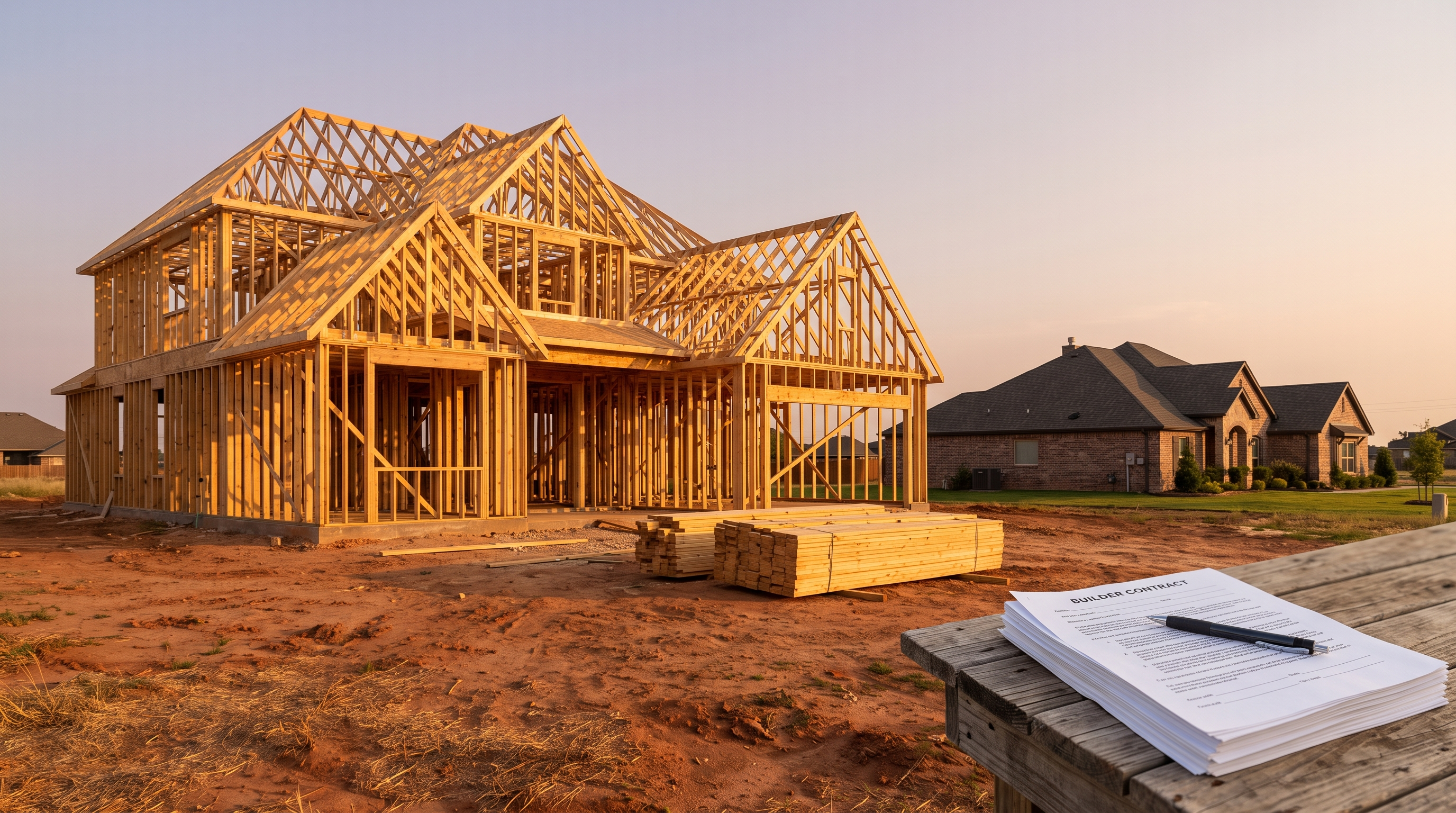
Your earnest money on a Glenn Heights new build doesn't work like a resale deposit (2026)
Your earnest money on a Glenn Heights new build doesn't work like a resale deposit (2026)
By Steven J. Thomas
You are sitting in a model home off Hampton Road in Glenn Heights. The floor plan works. The homesite faces the right way. The rep slides a contract across the table and mentions that most people sign the same day to hold the lot. Here is the part nobody says out loud: that contract is not the one you signed on your last house in DeSoto or Cedar Hill, and the deposit rules inside it are not the ones you remember.
The short answer
On a Glenn Heights resale you sign a TREC 1-4 Family contract with a paid option period and earnest money held by the title company. A builder's purchase agreement is a private document written by the builder's attorney. It usually has no TREC-style option period, deposits often run 3% to 5% of the price, and refundability commonly ends when the builder pulls a permit and starts construction on your homesite.
The builder rep works for the builder, and so does the contract
The person in the model home is friendly, informed, and good at their job. Their job is to represent the builder. That is not a criticism. It is the arrangement, and it should be disclosed to you in writing before you sign anything.
What most move-up buyers miss is that the same loyalty runs through the paperwork. When you buy a resale in Glenn Heights, both sides use a contract promulgated by the Texas Real Estate Commission. Neither the buyer nor the seller wrote it. It is the same form for everybody, and it has consumer protections baked in because a state agency put them there.
A builder contract is a different animal. It was drafted by attorneys who work for the builder, for the builder's benefit, on the builder's paper. Builders are generally not required to use the TREC form on their own new construction sales. So the deposit rules, the termination rules, the completion-date language, and the remedies are whatever that specific builder decided they should be.
That is the one take of this whole article. The rep works for the builder, and so does the contract. Everything below is what that actually costs you if you do not read it.
What a TREC resale contract gives you that a builder contract usually does not
On a TREC 1-4 Family Residential Contract, a Texas buyer typically has two separate protections working at once.
- A paid, negotiated option period. You pay a small option fee directly to the seller, commonly a few hundred dollars, and in exchange you get an unrestricted right to terminate for any reason during that window. You do not have to explain yourself. You do not have to find a defect. You just terminate.
- Earnest money held by a third party. The larger deposit goes to the title company, not to the seller's bank account. On a resale, earnest money commonly runs 1% to 2% of the price in this market, and if you terminate inside the option period, it comes back.
Now hold that up against a builder contract. In most builder purchase agreements I read in the southwest DFW corridor, there is no TREC-style option period at all. There may be a short review or rescission window written into the builder's own terms, and there may not be. The deposit is set by the builder. Who holds it is set by the builder. What makes it non-refundable is set by the builder.
None of that is illegal or shady. It is a private contract between two parties, and you are one of the two parties. It only becomes a problem when a buyer signs it believing the resale rules still apply.
The deposit math on a $750,000 build
Let's put real numbers on it, because "3% to 5%" does not land until you write the check.
Many production and semi-custom builders in this corridor ask for 3% to 5% earnest money on a to-be-built home. On custom and semi-custom work the ask can run higher, and some builders require additional deposits at construction milestones such as slab pour, framing, or drywall.
On a $750,000 build:
- 3% earnest money: $22,500
- 4% earnest money: $30,000
- 5% earnest money: $37,500
So the range is roughly $22,500 to $37,500 on the front end. Compare that to a $750,000 resale in Midlothian at 1% earnest money, which is $7,500, plus a $300 option fee that buys you an unrestricted exit. Same price point. Very different exposure.
Then add the second layer. If your builder requires milestone deposits, another 1% to 2% can follow at slab or framing. If your contract calls for a lot premium deposit on a corner or greenbelt homesite, that is separate money too. I have seen buyers in the $600,000 to $950,000 band commit north of $50,000 in total deposits before a single wall goes up, and the great majority of them had no idea that was the plan when they signed.
Here is a typical front-end cost picture for a to-be-built home in this price band, based on current conditions in the corridor:
- Earnest money deposit: 3% to 5% of contract price, higher on custom and semi-custom
- Milestone or construction-draw deposits: 0% to 2%, builder dependent
- Design center and upgrade deposit: commonly 25% to 100% of the upgrade total, due at selections
- Lot premium: $5,000 to $60,000 depending on the homesite, sometimes deposited separately
- Third-party inspections during construction: $400 to $900 per phase, and worth every dollar
- MUD or PID assessments in newer communities: an annual tax line, not a deposit, but it changes your payment
None of those numbers are guarantees. They are ranges I see in this corridor right now, and every builder sets its own. The point is that the total is large enough to deserve a careful read before you initial anything.
The refundability trigger nobody explains: permit and start of construction
This is the section I would tattoo on a buyer's forearm if they let me.
On a to-be-built home, sometimes called a dirt start, the deposit is commonly refundable during a short financing window at the front of the contract. If your loan is denied inside that window and you gave the builder what they asked for on time, many contracts return the deposit. That window is often measured in weeks, not months.
After that, the trigger that flips your money from refundable to non-refundable is usually not a date on the calendar. It is an event. In most builder contracts I read, that event is the builder pulling the permit and starting construction on your specific homesite.
Think about why that makes sense from the builder's side. The moment they permit and break ground on your plan, your elevation, your structural options, and your lot, they have spent real money on a house configured for you. Their contract protects that spend. Perfectly rational.
The problem is what it does to your timeline. A dirt start in Glenn Heights or Red Oak commonly takes six to ten months from contract to closing, based on current build cycles and weather. If the permit pulls in week five, your deposit has been non-refundable for the other seven or eight months of that build. That is a long stretch for your loan file to stay perfectly clean.
Ask this question out loud, in the model home, before you sign: what specific event makes my deposit non-refundable, and where in this contract does it say so? Then read that paragraph yourself. Then have your agent read it. For anything you do not like, have a real estate attorney read it before you sign. I am a broker and a loan officer, not your lawyer, and contract language is a lawyer's job.
Design center money is separate money
The design center is where new construction budgets go sideways. It is also where a lot of deposit money quietly changes character.
In most builder contracts, design center and upgrade deposits are non-refundable regardless of when or why the deal falls apart. Not "non-refundable after construction starts." Non-refundable, period, in a lot of agreements.
The logic is the same as the permit trigger. The builder ordered your quartz, your cabinet package, your extended covered patio, and your structural bump-out. Some of that is custom-ordered and non-returnable the day you select it. So the contract treats it as spent.
Here is how that plays out in real life. Take a composite buyer, because I am not going to put a real client's business on the internet. Call them a move-up couple selling in DeSoto and building at $780,000 in the corridor. They put 3% down as earnest money, which is $23,400. They then spend $62,000 at the design center and put down half at selections, another $31,000. Their loan hits a snag nine months later because one of them changed jobs from W-2 to 1099 income during the build. Under many builder contracts, the earnest money fight is at least arguable if they can show they acted in good faith. The $31,000 in design center money is usually not arguable at all.
Design center money is separate money. Treat it that way in your budget and in your risk math.
Where the financing contingency actually lives
Buyers hear "financing contingency" and assume it works like a resale third-party financing addendum. Sometimes it is close. Often it is narrower.
Generally speaking, a buyer who acts in good faith, applies when the contract says to apply, provides documentation on time, qualifies, and whose lender is prepared to close on schedule is in a much stronger position on deposit return than a buyer who slow-walked the process or changed their financial picture mid-build. That is the general shape of it across contracts I read.
But the terms live in the specific contract, not in a general rule. Some agreements require you to apply with the builder's preferred lender to keep the incentive package. Some require written loan denial within a fixed number of days. Some define "qualified" by the builder's own standard rather than your lender's. Read the financing section with the same attention you gave the floor plan.
The practical version of this: the moment you go under contract on a build, your loan file has to stay frozen. No new car. No furniture financing for the house you have not moved into yet. No job change, even a promotion, without talking to your loan officer first. No large unexplained deposits into your accounts. That advice sounds obvious in August and gets forgotten by February.
Glenn Heights and the southwest DFW build corridor right now
Glenn Heights
Glenn Heights sits between DeSoto and Red Oak on I-35E, roughly 20 minutes from downtown Dallas on a good morning. Most of the city is zoned to Red Oak ISD, with portions in DeSoto ISD and Ferris ISD, so verify the assignment for the specific homesite rather than the community. Active new construction communities include Maplewood, Hampton Park, and The Villages at Charleston, with builders such as Bloomfield Homes, First Texas Homes, Kindred Homes, and D.R. Horton building here in 2026. Glenn Heights is one of the lower entry points for new construction in southwest DFW. Buyers shopping the $600,000 to $950,000 band here are usually looking at larger homesites, build-on-your-lot options, or semi-custom work rather than the standard production inventory. If you want the full community-level rundown, I keep a Glenn Heights new construction guide updated for 2026.
Red Oak
Red Oak is the next exit south and pulls a lot of the same move-up buyers. It is Ellis County, Red Oak ISD, and it has a mix of production communities and larger-acreage build-on-your-lot opportunities that reach comfortably into the semi-custom price band. Because Red Oak has more custom and semi-custom activity than Glenn Heights, it is also where I see the higher deposit asks. Custom and semi-custom builders here are more likely to want 5% or more up front and more likely to write milestone deposits into the agreement. If you are cross-shopping communities across cities, the DFW new construction hub lists what is active by city.
Waxahachie and Midlothian
Waxahachie and Midlothian carry the larger lot sizes and the longer build cycles in this corridor, which matters directly to this topic. A longer build means your deposit sits at risk across more months, and more months means more chances for something in your loan file to move. Midlothian ISD and Waxahachie ISD both draw move-up buyers out of Dallas County, and both cities have communities where the $600,000 to $950,000 band is normal rather than exceptional. Same contract questions apply. Ask them earlier, because the exposure window is longer.
What current rate conditions mean for money sitting in a builder's account
Here is the market backdrop, framed as current conditions and nothing more.
- 30-year fixed averaging about 6.77% as of mid-August 2026, per LendingTree
- Fannie Mae's June 2026 forecast projects roughly 6.4% for the remainder of 2026, per the Fannie Mae Housing Forecast
- The Mortgage Bankers Association projects about 6.5% in Q3 and Q4 2026, per the MBA forecast
Those are survey averages and forecasts published by the sources named above, not a rate quote, an offer of credit, or an APR from Envision Home Lenders, NMLS #689220. Your own rate, APR, and terms depend on your file and on conditions the day you lock.
Two things follow from those numbers. First, builders are still using incentives and rate buydowns aggressively, and new construction is often priced competitively against comparable resale inventory in this corridor. That is genuinely good for buyers, and it is a real reason to look at a build. I track what is being offered on the DFW builder incentives page.
Second, and this is the part that connects back to your deposit: forecasts that sit in a narrow band around 6.4% to 6.5% are not a promise. Rates move. Underwriting guidelines move. Your income documentation moves. A build that takes six to ten months means your deposit is exposed across a stretch of time where your loan file has to stay clean the entire way. Nobody can guarantee where rates land, and I am not going to pretend otherwise.
"On a resale I am watching a 30-day window. On a dirt start I am watching a nine-month window with tens of thousands of dollars of the buyer's money already committed. Those are different jobs." — Steven J. Thomas, Broker at Refind Realty DFW and Loan Officer at Envision Home Lenders
What to actually do before you sign
None of this is a reason to avoid new construction. It is a reason to read the paperwork the way you would read a loan disclosure. Do these things in this order.
- Read three sections yourself, out loud if you have to: the deposit section, the financing section, and the completion-date section. Those three carry most of your money risk.
- Ask for the full deposit schedule in writing. Total dollars, due dates, and what triggers each one. Not a verbal summary from the rep. In writing.
- Ask what specifically makes the deposit non-refundable. Get the answer, then find the paragraph in the contract that says it. If the answer and the paragraph do not match, stop.
- Find out who holds the money. Builder-controlled account or title company escrow. Those are very different levels of protection, and the answer is in the contract.
- Ask what happens if the completion date slips. Many builder contracts give the builder wide latitude on delivery timing. Know what your remedy is, if you have one.
- Have your agent read the whole thing. For anything you do not like, have a real estate attorney read it before you sign. This article is general information, not legal advice.
Bring your own agent to the first visit
This one costs people representation for free, and it is entirely avoidable.
Most builders in this corridor still offer a co-op commission toward the buyer's agent, and where they do, it is generally already built into the price of the home. Whether that co-op covers your agent's fee in full is set out in your written buyer representation agreement, so ask before you tour. What you should not do is walk away from representation that may already be sitting inside the number.
The catch is builder registration rules. Most builders require your agent to be present and registered on your first visit, or in some cases to register you in advance. Walk into the model home alone on a Saturday, sign the visitor card, and you may have permanently disqualified your own agent from representing you on that community. The rep is not going to volunteer that. It is in the sign-in fine print.
So bring your agent to the first visit. Every time. Even if you are just looking. Especially if you are just looking.
Why I read the deposit clause and the loan file the same week
I am a real estate broker and a licensed loan officer, NMLS #689220. That combination is unusual, and on new construction it matters more than on any other kind of transaction.
Most agents see one side. They read the contract and hand the financing to someone else. Most loan officers see the other side. They read the loan file and never open the purchase agreement. On a builder contract, the deposit clause and the financing contingency are wired together. What counts as "qualified," when your denial letter has to land, whether the builder's preferred lender is required to keep the incentive, how a job change nine months into a build affects your standing under the good-faith language, all of that sits at the seam between the two documents.
I read both in the same week, for the same client, and I can tell you before you sign whether your loan profile lines up with the deposit terms you are being asked to accept. Twenty years in financial services and a finance degree from Baylor is what makes that a normal Tuesday instead of a specialty project.
The one thing to remember
The builder rep works for the builder, and so does the contract. That is not a warning about bad actors. It is a description of who wrote the document and whose interests it protects. On a Glenn Heights resale you get a state form, a paid option period, and earnest money at the title company. On a Glenn Heights new build you get a private agreement with a 3% to 5% deposit, a refundability trigger tied to a permit and a shovel, and design center money that usually does not come back. Read the deposit, financing, and completion sections before you sign. Ask what triggers non-refundability and where it says so. Bring your agent to the first visit, because the co-op is already priced in and the registration rules are unforgiving.
If you want the full walkthrough of the builder contract process in southwest DFW before you sit down in a model home, download the free New Construction Buyer Guide.
Key takeaways
- A builder purchase agreement is written by the builder's attorney and usually has no TREC-style option period, so the unrestricted right to terminate you had on your last resale is generally not in the document.
- Builder earnest money commonly runs 3% to 5%, which is $22,500 to $37,500 on a $750,000 build, and can go higher on custom and semi-custom work with additional milestone deposits.
- On a dirt start, the deposit is often refundable during a short financing window and typically becomes non-refundable when the builder pulls the permit and starts construction, not on a calendar date.
- Design center and upgrade deposits are usually non-refundable regardless of when or why the deal falls apart, so budget that money as separate from your earnest money.
- With the 30-year fixed averaging about 6.77% as of mid-August 2026 per LendingTree and builds running six to ten months in this corridor, your deposit is exposed for the entire time your loan file has to stay clean.
Frequently asked questions
Does a Texas builder have to use the TREC 1-4 Family contract?
Generally no. Builders selling their own new construction typically use their own purchase agreement drafted by their attorneys. The TREC promulgated forms are used by license holders in resale transactions, which is why the terms you remember from your last purchase may not appear in a builder contract.
How much earnest money will a builder ask for in Glenn Heights?
Many builders in the southwest DFW corridor ask for 3% to 5% of the contract price, higher on custom and semi-custom builds. On a $750,000 home that is roughly $22,500 to $37,500, and some contracts add further deposits at construction milestones.
Can I get my deposit back if my loan is denied on a new build?
It depends entirely on that contract's financing language. Generally, a buyer who applies on time, documents in good faith, qualifies, and whose lender is prepared to close is in a much better position on deposit return. The specific terms live in your agreement, so have your agent and a real estate attorney read it before you sign.
Who holds the earnest money on a builder contract, the builder or the title company?
Either, depending on the builder. On a TREC resale the title company holds it as escrow agent. On a builder contract the money may sit in a builder-controlled account instead. Ask the question directly and confirm the answer in the contract text.
How long is a to-be-built home in Glenn Heights or Red Oak under construction?
Dirt starts in this corridor commonly run six to ten months from contract to closing based on current build cycles and weather, with longer lot sizes in Waxahachie and Midlothian often at the upper end. Nobody can guarantee a completion date, which is exactly why the completion-date section of the contract is worth reading.
Where can I see what is actually being built in Glenn Heights right now?
Active communities in Glenn Heights include Maplewood, Hampton Park, and The Villages at Charleston, with builders including Bloomfield Homes, First Texas Homes, Kindred Homes, and D.R. Horton active in 2026. City-by-city inventory across the corridor is listed on the DFW new construction hub, and community lineups change as sections release.
Steven J. Thomas is a Texas real estate broker at Refind Realty DFW and a loan officer at Envision Home Lenders, NMLS #689220, based in DeSoto, TX. Office: 128 S. Cockrell Hill Rd, DeSoto, TX 75115. Phone 972-846-9170. This article is general information about how builder contracts commonly work in southwest DFW and is not legal advice. Have your agent and a real estate attorney review any contract before you sign it. Market data reflects current conditions as of August 2026 and is not a prediction or a guarantee of prices, rates, timelines, or outcomes. Equal Housing Opportunity.


