Your Fence May Be Sitting on the Neighbor's Lot: A 2026 Duncanville Seller's Guide to Survey Encroachments and Utility Easements
Your Fence May Be Sitting on the Neighbor's Lot: A 2026 Duncanville Seller's Guide to Survey Encroachments and Utility Easements
By Steven J. Thomas
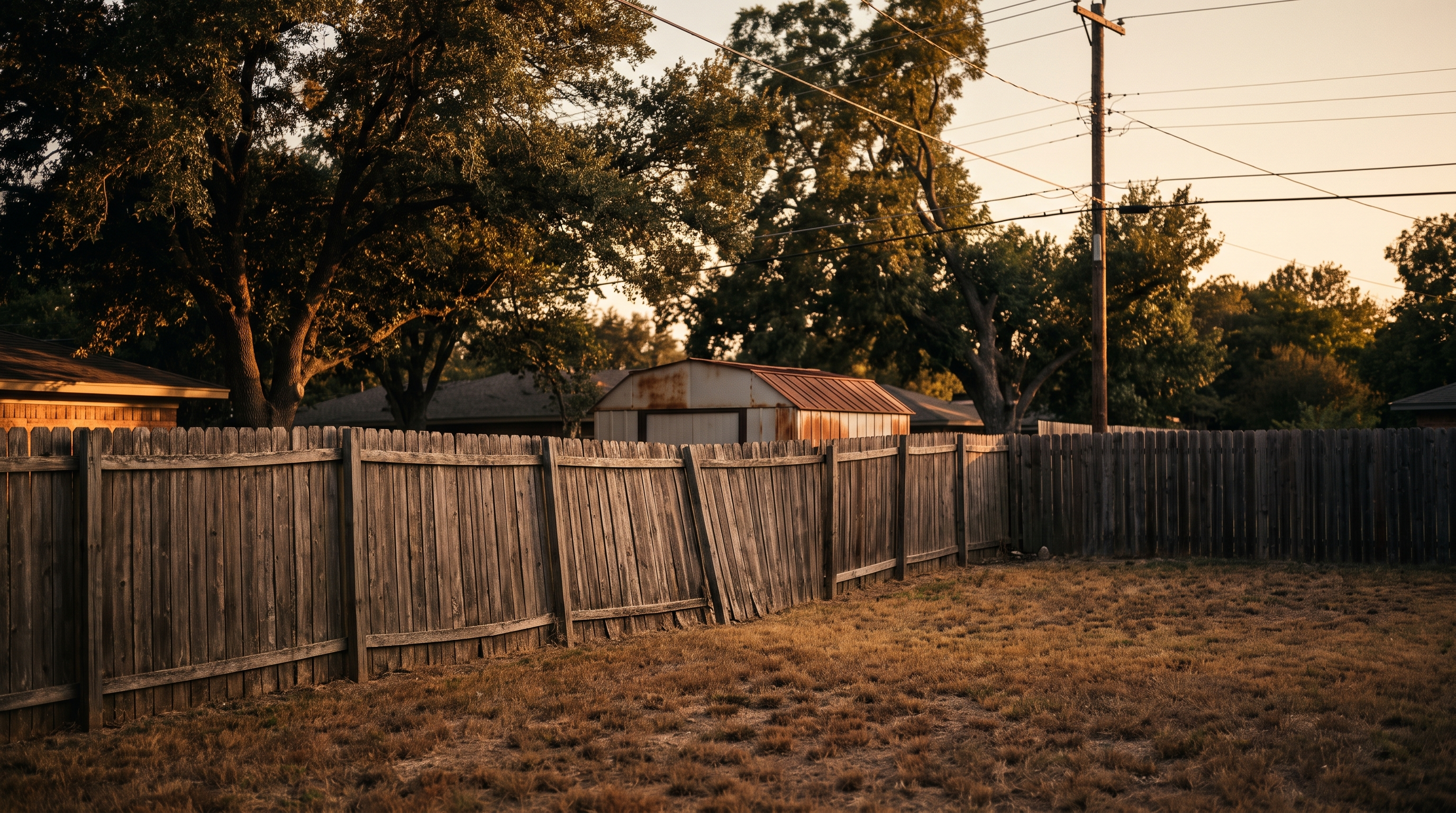
[Caption: A chain-link and cedar fence line running behind a 1970s brick ranch home in Duncanville, Texas, with a metal storage shed pushed tight against the rear lot line.]
Most Duncanville homeowners have never actually looked at their own property survey. The fence was already there when they bought the house, the shed came with it, and the driveway has been poured that way for forty years. Then a buyer's title company orders a survey, a crew stakes the corners, and the drawing comes back showing the fence sitting two feet inside the neighbor's lot. That is the moment a clean sale turns into a negotiation you did not plan for.
Direct answer
When a survey shows your Duncanville fence, shed, driveway, or pool crossing the property line or sitting inside a recorded utility easement, the title company adds an exception to the title commitment and your buyer gets a chance to object. You clear it three ways: a signed boundary line agreement with the neighbor, a written encroachment agreement or license, or moving the structure. Handle it before you list, alongside the other common deal-killers that derail a Dallas-area home sale.
What a boundary survey actually shows
A residential boundary survey is a measurement, not a ruling. The surveyor pulls the recorded plat and the county records, locates the corners of your platted lot, then measures where every improvement sits relative to those lines. The finished drawing plots the house footprint, the driveway and walks, the fences, the shed, the pool and pool deck, the AC pad, and any easements that show up in the title work.
The useful part is the numbers. A survey does not say "the fence is a little off." It says the fence is 1.8 feet east of the line, or that the storage building sits 3.2 feet inside the rear utility easement. Easements get drawn as hatched strips, usually a five-foot or seven-and-a-half-foot band along the rear alley in older Duncanville plats, sometimes a side strip, sometimes a drainage easement cutting a corner.
Here is what a survey does not do. It does not decide who owns the disputed strip of dirt. It does not settle an argument with your neighbor. It does not grant anybody permission to keep a structure where it sits. It simply puts the problem in writing, in feet and tenths, in front of a title underwriter who now has to decide what to insure.
Where this shows up around Duncanville
Fairmeadows and the early-1960s platted lots
Duncanville grew quickly in the early 1960s, and Fairmeadows helped push the city past 10,000 residents by 1964. Those lots were platted with utility easements running behind the houses, and the original fences went up along whatever line the builder's crew used that week. Sixty years later, most of those fences have been replaced two or three times. Each replacement crew set posts a few inches off the last post holes, because that is where the ground was easiest to dig. Three replacements at four inches each is a foot of drift. Sellers in these blocks should work from a current survey rather than memory, and our DFW home seller guides walk through the rest of the pre-listing paperwork.
Green Hills and the larger-lot pockets
Some Duncanville homes sit on notably bigger parcels, including acre-sized lots in the Green Hills area. More land means more room for a detached garage, a workshop, an above-ground pool, a long gravel drive, or a barn-style shed. It also means the property corners sit far from the house, well past the point where anyone can eyeball a line. Large-lot encroachments tend to be bigger in raw footage and more expensive to move, so the paperwork route usually wins. Before you set a price on one of these, pull the recent sold data in our Dallas-Fort Worth neighborhood reports so you know what comparable acreage has actually traded for.
The rear alley strip, from Duncanville into DeSoto and Cedar Hill
Rear-alley subdivisions run all through southwest Dallas County. The alley carries the utility line, the plat carries the easement, and the back fence marks where the yard stops. Homeowners fill that back strip with sheds, pool pumps, concrete pads, and raised beds because it is the only part of the yard nobody looks at. A surveyor looks at it. So does the utility. Add this to your pre-listing walk using the Dallas home seller checklist.
Pro Tip: Book a Home Selling Score walk-through before you list. It is a 30-minute in-person walk of the property with me, and the property lines get looked at the same way a buyer's surveyor will look at them.
The T-47, and when your old survey still works
Texas gives sellers a path to reuse an existing survey instead of buying a new one. If you have a prior survey and the buyer and title company accept it, you sign either a T-47 Residential Real Property Affidavit, which is notarized, or a T-47.1 Residential Real Property Declaration, which is not. The Texas Department of Insurance publishes both forms, and the Texas Real Estate Commission amended Paragraph 6C(1) of the 1-4 Family Residential Contract to add the T-47.1 option, with the updated forms available beginning November 1, 2024 and mandatory as of January 3, 2025. The declaration requires your date of birth and can be signed electronically, which is why most southwest Dallas County closings now use it.
The substance of both documents is the same. You are swearing, in writing, that this is the survey of your property, that it is dated as shown, and that nothing has changed since. No new fences. No new structures. No boundary disputes you know about. The title company relies on those statements to give area and boundary coverage.
That is where sellers get into trouble. If you poured a patio in 2020, replaced the back fence in 2022, or dropped a shed on a slab in 2023, and your survey is from 2009, the survey no longer matches the property. You cannot truthfully sign that nothing changed, and you should not try. A new survey is also required when the buyer's lender demands one, when the old drawing is illegible, or when the improvements on it simply are not the improvements standing in the yard today.
None of this is legal advice. Your title company or a Texas real estate attorney should be the one telling you which form fits your file.
Local market trends, summer 2026
- Median sale price, Duncanville: roughly $284,000 over the three months ending May 2026, down about 6.9% year over year (Source: Redfin Duncanville housing market, May 2026)
- Average days on market, Duncanville: about 47 days, compared with about 40 days a year earlier (Source: Redfin, May 2026)
- 30-year fixed mortgage rate: 6.65% for the week of August 20, 2026, down from 6.67% the prior week (Source: Freddie Mac Primary Mortgage Market Survey, August 2026)
- Residential boundary survey, Dallas County: roughly $350 to $600 for a typical platted suburban lot, and roughly $800 to $2,000 where the plat is older or the records are thin (Source: Find Land Surveyor Dallas County cost guide, 2026)
Read those first two numbers together. Prices in Duncanville have softened while the average sale is taking about a week longer than it did last year, so buyers have room to be picky and lenders have room to be careful. Based on current conditions, that means a survey exception discovered in the second week of the option period lands on a buyer who already feels like they have choices. Track the wider county picture in our DFW real estate market statistics hub.
"A survey exception is not a title defect. It is a question nobody bothered to answer. Answer it before you list and it costs you a signature. Answer it during the option period and the buyer decides what the answer is worth." - Steven J. Thomas, Broker at Refind Realty DFW and Loan Officer at Envision Home Lenders
How the encroachment lands in the title commitment
Schedule B, Item 2 of every Texas title commitment carries the same exception: any discrepancies, conflicts or shortages in area or boundary lines, and any encroachments, protrusions, or overlapping of improvements. That language is standard, and it is in your file whether or not anyone ever orders a survey.
Buyers can pay an additional premium for area and boundary coverage, sometimes called survey deletion, which narrows that broad exception down to shortages in area only. Here is the catch sellers miss. Survey deletion does not erase a problem the survey actually found. When the drawing shows a specific fence over a specific line, the title company typically adds a specific exception naming that encroachment, and the specific exception survives the deletion.
At that point the buyer may object under Paragraph 6D of the TREC 1-4 Family Residential Contract, within their objection deadline. If they object, you are negotiating a cure, a credit, or a termination. If they do not object, the sale can close, but the encroachment stays outside the policy, so a dispute later on is not covered. Sellers sometimes read that second outcome as getting away with it. What it really does is hand an unresolved question to the next owner, and unresolved questions have a way of finding an attorney eventually.
Your three ways to clear it
Option one is a boundary line agreement. Both property owners sign a document confirming that the true boundary is the surveyed line and not the fence, and the party whose structure crosses over waives any interest in the strip. The agreement gets recorded in Dallas County. Title companies generally remove the boundary exception once they have one in hand.
Option two is an encroachment agreement or a license. Use this when nobody wants to move anything. The neighbor grants written permission for your structure to stay where it is, often revocable, and often terminating whenever the structure is replaced. It does two jobs at once: it satisfies the title company, and it puts on the record that the use is permissive.
Option three is moving the structure. This gets dismissed too fast. Resetting forty feet of wood fence is frequently cheaper and usually faster than three months of negotiating with a neighbor who has decided the strip is theirs. If the encroachment is small and the structure is light, move it and be done.
Whichever route you take, the document should be drafted by a Texas real estate attorney or prepared through your title company. I can coordinate that and get it in front of the underwriter early, but I am a broker, not your lawyer, and this article is not legal advice.
When the structure sits inside a utility easement
A recorded utility easement is a different animal from a neighbor dispute, because the party on the other side is not going to negotiate the way a neighbor will. The easement gives the utility the right to enter, dig, and maintain its equipment. You still own the dirt. You do not get to block the access.
Texas utilities generally take the position that permanent structures do not belong inside the easement: no sheds, no garages, no concrete pads, no pool decks. Fences are often tolerated informally, right up until a crew needs to get a backhoe to a line. When something has to come out, the removal is typically at the property owner's expense, and there is usually no compensation for the structure that gets torn out. Written approval before construction is the only reliable protection, and almost nobody who dropped a shed in the back corner in 2019 ever asked for it.
If your survey shows something inside the easement, call the City of Duncanville and the utility that holds it, and ask whether they will issue a license or encroachment agreement. Some will. Some will not. Either way, disclose it. The Texas Seller's Disclosure Notice asks directly about encroachments and easements, and a survey sitting in your file is exactly the kind of thing you are supposed to disclose. The expensive version of this problem is a pool or a pool deck built across an easement line, because there is no cheap way to move concrete.
Adverse possession, in plain English
Suppose the fence goes the other direction, and your neighbor's fence has enclosed part of your yard for years. Texas Civil Practice and Remedies Code Section 16.026 sets a ten-year limitations period for adverse possession. If someone uses land openly, exclusively, continuously, and without the owner's permission for ten years, they can file suit to claim it, with no deed and no title document needed.
Do not panic about a few inches. Texas courts have declined to hand over land on trivial encroachments, including a nine-inch fence overlap in McAllister v. Samuels that the court found too slight to put the true owner on notice that anyone was claiming the land. The Texas A&M Real Estate Research Center has a plain-language piece on fences and adverse possession that is worth twenty minutes of your time.
The practical reading for a Duncanville seller is simple. A few tenths of a foot is a paperwork problem. Three feet with a shed, a garden, and a gate on it is a legal question, and the ten-year clock matters. The cheapest protection is a written license, because permission defeats the "without the owner's permission" element. Again, that is a conversation for an attorney, not for a blog post.
What it costs and how long it takes
- New residential boundary survey, typical Duncanville platted lot: about $350 to $600
- Older plat, odd lot shape, or incomplete records: about $800 to $2,000
- Rush turnaround fee: commonly 25% to 50% on top of the base fee
- Attorney-drafted boundary line agreement or encroachment license: commonly $500 to $1,500 depending on complexity
- Dallas County recording fee: typically under $100
- Relocating 40 to 60 feet of wood privacy fence: roughly $1,500 to $4,000 installed
- Relocating a metal or wood storage building: a few hundred dollars up to a couple of thousand
- Removing concrete drive, patio, or pool decking: several thousand, depending on square footage and access
Ranges above are typical Dallas County estimates based on current conditions and published surveyor cost guides. They are estimates, not quotes, and actual pricing varies by vendor, lot, and scope.
On timing, based on current conditions, a residential survey in Dallas County usually comes back in about one to three weeks. The unpredictable piece is the neighbor. Getting a signature from someone who likes you and understands what you are asking can take an afternoon. Getting one from someone who suspects a trap can take months, and no agent can promise you an outcome there.
Weigh those numbers against the alternative. On a Duncanville sale near the $284,000 median, a buyer who objects at the deadline and asks for a concession is rarely asking for $600. Compare our home selling options if the timeline pressure is what worries you most.
The pre-listing move: pull the survey now
- Find the survey you already have. Look in the closing packet from when you bought the house. If it is not there, call the title company that closed your purchase, because many keep the file.
- Walk the property lines with the drawing in your hand. Check the fence on all sides, the shed, the driveway, the AC pad, the pool and its equipment, and whatever is living in the rear easement strip.
- Order a new survey if you have added, replaced, or moved anything since the last one. Do it now, not after you have a contract, when the surveyor's calendar becomes somebody else's problem too.
- Talk to the neighbor while nothing is at stake. People sign reasonable documents when there is no closing date hanging over the conversation. They dig in when there is.
- Get the agreement drafted and recorded through an attorney or your title company.
- Hand the survey, the T-47 or T-47.1, and any recorded agreement to the title company the day the file opens.
What today's rates have to do with your fence
Buyers financing a Duncanville purchase at 6.65%, the Freddie Mac average for the week of August 20, 2026, are working with tight monthly numbers and not much appetite for surprises. When a survey exception shows up in week two of the option period, it gives a nervous buyer a clean, defensible reason to walk. It also gives an underwriter a reason to slow the file down while everyone waits on a document nobody started.
Clearing the boundary question before you list takes that lever off the table. It is one of the few pre-listing tasks with a knowable cost and a direct bearing on whether the deal holds together. Rates and loan terms referenced here come from published survey data, are subject to change and credit approval, and are not an offer of credit or a commitment of terms. Steven J. Thomas, Loan Officer, Envision Home Lenders, NMLS #689220.
Conclusion
A fence over the line is not a reason to be afraid of selling your Duncanville home. It is a document problem with three known solutions and a predictable price tag, and every one of those solutions gets easier the earlier you start. What turns it into a real problem is finding out on day twelve of a contract, when your buyer has a deadline, an inspector's list, and an agent telling them they have options. Pull the survey, walk the lines, and make the phone call to your neighbor while it is still a friendly conversation. Based on current conditions in Dallas County, that is a few hundred dollars and a couple of weeks well spent.
- Grab the seller pitfalls guide and see the other issues that quietly derail Dallas-area home sales: Avoiding These Pitfalls That Can Derail Your Dallas Home Sale
- Get your Home Selling Score with a 30-minute in-person walk-through of your Duncanville property: Get Your Home Selling Score
- Download the Lone Star Living App to watch what is listing and selling around your block: Lone Star Living App
- Book an appointment today and we will look at your survey together: stevenjthomas.com/book
You're Always Home with Steven J. Thomas.
Disclosure: This article is general information about Texas surveys, title commitments, easements, and boundary documents. It is not legal advice and does not create an attorney-client relationship. Have a licensed Texas real estate attorney or your title company review your specific survey, title commitment, and any boundary line or encroachment agreement before you sign or record it. Market data reflects current conditions and is subject to change. No outcome, price, or timeline is guaranteed.
Steven J. Thomas - Broker, Refind Realty DFW - TREC Broker License #0657467 - Loan Officer, Envision Home Lenders - NMLS #689220. Equal Housing Opportunity. This article is general information for Texas homeowners and is not legal advice.
Key takeaways
- Schedule B, Item 2 of every Texas title commitment already excepts encroachments and boundary conflicts, so a survey that finds your fence over the line creates a specific exception your buyer can object to under Paragraph 6D.
- An existing survey can be reused with a signed T-47 affidavit or a T-47.1 declaration, but only if nothing has been built, replaced, or moved since that survey was drawn.
- A recorded boundary line agreement signed by both neighbors is the cleanest fix, and title companies generally remove the exception once they have one.
- A structure inside a recorded utility easement can be required to come out at your expense, with no compensation, so written approval from the utility matters more than a handshake.
- Duncanville homes averaged about 47 days on market with a median sale price near $284,000 as of May 2026 per Redfin, which means a survey problem found mid-contract can cost you weeks you cannot get back. Track your block in the Lone Star Living App.
FAQ: Duncanville survey encroachments and easements
When should a Duncanville seller order a survey?
Order it before you list, not after you have a contract. A Dallas County residential survey usually takes about one to three weeks, and finding a problem early gives you time to fix it without a buyer's deadline pushing you.
Who pays for the survey in a Texas home sale?
It is negotiable in the TREC 1-4 Family Residential Contract, and either side can end up paying. Sellers who bring a current survey and a signed T-47 or T-47.1 to the table often avoid the cost entirely and control the timeline.
What happens if the buyer objects to a fence encroachment?
You negotiate a cure, a price concession, or a termination inside their objection window. If they do not object, the sale can still close, but the encroachment stays excluded from the title policy and the issue passes to the next owner.
Can I leave a shed in a Duncanville utility easement?
Only if the utility and the city agree in writing. Without written approval, a structure inside a recorded easement can be removed at the owner's expense, typically with no compensation for the structure.
How long does it take to clear a boundary encroachment before closing?
The survey runs about one to three weeks and an attorney-drafted agreement can often be prepared in days. The variable is your neighbor's signature, which is why the conversation should happen before you list.
Where can I see what is actually selling near me in Duncanville?
Download the Lone Star Living App to track active listings, pending sales, and closed prices around your street in Duncanville, DeSoto, and Cedar Hill.


