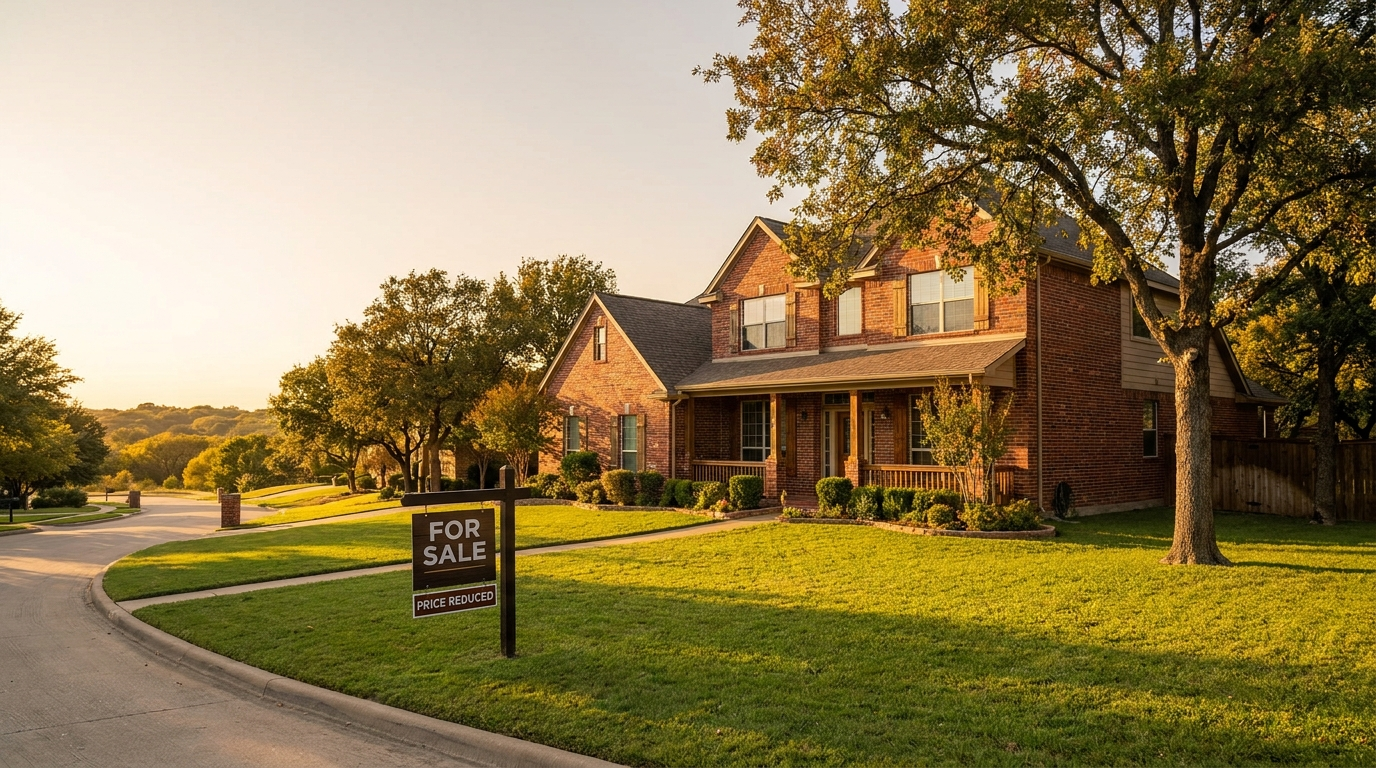
Cedar Hill Home Pricing 2026: Avoid the Price-Cut Spiral
Cedar Hill home pricing in 2026: why the price-cut spiral costs you more than pricing it right
By Steven J. Thomas
You own a home in Cedar Hill. You bought it five, maybe ten years ago, and you have watched the value climb. Now you want to sell and move up, and the first thing you do is pull up Zillow to see what your house is worth. That number feels good. It also might be the most expensive number you look at all year. In a Cedar Hill and southwest DFW market that has shifted toward buyers, pricing high on day one and cutting your way down usually nets you less than pricing it right from the start. Let me show you the math, and let me show you why an algorithm can't price your house.
Direct answer: should you price high and negotiate down?
No. Based on current conditions in Cedar Hill and DFW, overpricing a home wastes the first two weeks of buyer attention, then forces one or more price cuts that signal weakness to the market. The home usually sells for less than a correct day-one price would have produced. An online estimate can't see your condition, updates, or street. A real price comes from an in-person home walk-through and pricing review, not from a computer guess.
Cedar Hill isn't one market, and Zillow prices it like it is
Cedar Hill sits on the hills above Joe Pool Lake, and that geography alone breaks any automated model. A house backing up to Cedar Hill State Park or with a lake view is a different animal than one two streets over with no view, even when the square footage matches. Zillow can't see the view. It can't see the mature trees, the greenbelt, or the fact that one cul-de-sac stays quiet while another feeds onto a busy connector.
Lake Ridge and the west side
Homes around Lake Ridge and the western edge of Cedar Hill carry lot premiums an algorithm flattens into an average. Larger lots, custom builds, and proximity to the lake and the country club move price in ways a comp model built on zip-code medians will miss by tens of thousands. If you own out here and price off an online estimate, you may leave real money on the table. Pricing this pocket well means knowing which recent sales actually compare and which ones don't, something you can only sort out with a real value review of your specific home.
High Pointe, Plummer Creek, and the established grid
The established neighborhoods off Straus Road and around High Pointe trade on updates and condition more than location. Two identical floor plans can sell $30,000 apart based on whether the kitchen was touched since 2015. An automated estimate treats them as twins. A buyer walking through does not, and neither do I. This is exactly where overpricing punishes sellers hardest, because the buyer comparison is direct and unforgiving.
Newer construction near the tollway corridor
Newer sections closer to the 67 corridor and Uptown Village give buyers move-in-ready options with warranties. If your resale home has to compete against those, your price has to respect the difference in age and finish. Overpricing a 2014 home as if it were brand new just sends buyers down the road. Before you set a number, it helps to see how your home stacks up against everything currently active, which you can do inside the Lone Star Living home search app.
Pro tip: before you settle on any list price, get a real read on your home with a Home Selling Score walk-through. It's a 30-minute in-person visit and it tells you exactly what you're working with before the sign goes in the yard.
Local market trends (summer 2026)
Here is what the numbers say about the DFW market right now. Read these as current conditions, not a forecast, and definitely not a guarantee of what your house will do.
- The 30-year fixed mortgage sits around 6.49% (Freddie Mac PMMS, July 2026), so buyers are payment-sensitive and picky about price.
- The Dallas-Fort Worth-Arlington median list price is about $439,990 (Realtor.com via FRED, June 2026).
- Median days on market in DFW is roughly 51 days (Realtor.com, June 2026), up slightly year over year. Homes are taking longer.
- Active listings hit about 29,628 in June 2026, up around 13% from the January low (Realtor.com, June 2026). Buyers have more to choose from.
- About 40% of DFW active listings have already taken at least one price reduction, with a median cut near $12,500, roughly 3% of list price (Texas A&M Texas Real Estate Research Center and Realtor.com, spring 2026).
- The market is carrying roughly 5.2 months of supply, which is balanced-to-buyer-favorable territory.
Sit with that fifth point. Four out of ten sellers already cut their price, and the typical cut is $12,500. That is not a rounding error. That is the cost of guessing high and getting corrected by the market. When supply is up and days on market are climbing, buyers can wait you out, and an overpriced home gives them every reason to. You can see the broader picture anytime in the DFW market statistics dashboard. For the mortgage side that shapes buyer behavior, the weekly rate comes straight from Freddie Mac's Primary Mortgage Market Survey, and the inventory and days-on-market figures come from Realtor.com research and the Texas Real Estate Research Center at Texas A&M.
The overpricing math: how the price-cut spiral eats your equity
Most agents won't tell you this, because it is easier to win your listing by agreeing with the high number in your head. But the mechanism is simple, and it works against you every time.
Your listing gets its heaviest buyer attention in the first two weeks. That is when every serious buyer with a saved search, every agent with a matching client, and every neighbor who's nosy gets the alert. It is the one window where your home is new. If your price is wrong on day one, you spend that window teaching buyers that your house is overpriced. They tour it, compare it to the correctly priced home down the street, and move on. You don't get that window back.
Now the home sits. Days on market climb past that 51-day median. Buyers who watch the market start to notice the age of your listing, and a home that has been up for six or seven weeks reads as a problem, even when nothing is wrong with it. So you cut the price. That first cut, around $12,500 based on current DFW numbers, does not create fresh excitement. It confirms the suspicion buyers already had. Some of them wait, because a home that cut once often cuts again. You just trained them to hold out for the next reduction.
Then you cut again. By now you are chasing the market down instead of setting the pace. The eventual sale price usually lands below where a correct day-one price would have brought you, because a stale, twice-reduced listing negotiates from weakness. Run the rough math: a $12,500 cut, plus a second smaller cut, plus the extra weeks of carrying costs, taxes, insurance, and a mortgage on a house you are trying to leave. Overpricing rarely saves you anything. It usually costs you the exact equity you were trying to protect.
Correct pricing does the opposite. A home priced right for its condition and location draws the strongest activity during that first two-week window, competes well while buyers are actually looking, and holds its number because it never gave buyers a reason to doubt it. If you want to see the specific mistakes that trigger the spiral, the seller pitfalls guide lays them out.
What a real pricing walk-through covers that an algorithm can't
An online estimate averages public data. It does not walk your house. When I do a Home Selling Score visit, I am pricing the things a computer will never see, and those things are where your real number lives.
- Condition. Roof age, HVAC, the water heater, foundation movement common in our North Texas clay, and the small wear that adds up. A buyer's inspector will find all of it. Pricing has to account for it before the offer, not after.
- Updates. A renovated kitchen, updated baths, new flooring, fresh paint, and modern fixtures move your number up. Dated finishes move it down. An algorithm sees a 3-bed, 2-bath and stops there. I see whether it competes.
- Layout. Open concept versus chopped-up rooms, a real primary suite versus a converted bedroom, a functional flow versus a floor plan buyers walk out of. Livability sets price, and it is invisible to a model.
- The street. The lot, the view, the neighbors' upkeep, the traffic, and the corner-lot tradeoffs. Two houses on the same block are not the same listing, and Cedar Hill's hills make that gap wider.
- The right comps. Not every recent sale is a real comparable. I throw out the ones that don't match your condition, size, and pocket, and I weight the ones that do. That judgment is the whole game, and it is the part an automated estimate gets wrong most often.
That is the difference between a number and a price. The walk-through gives you a Home Selling Score, and it tells you whether your home is ready to list at your target or whether a few specific fixes will protect your equity first. If you would rather start with a checklist before I come by, the Dallas home seller checklist is a solid first step, and the full menu of paths lives on the home selling options page.
Price it right the first time
The Cedar Hill market in 2026 rewards sellers who set the right number on day one and punishes the ones who guess high and get corrected. With rates near 6.49%, inventory up, and 40% of DFW listings already reduced, buyers have the upper hand and plenty of patience. Your best shot at your target number is a price built on your home's actual condition and location, set before the sign goes up, not walked down over two months of watching it sit. I am Steven Thomas, a broker and loan officer based here in southwest DFW, and I price homes by walking them, not by trusting a screen. Here is where to start:
- Get your Home Selling Score with an in-person walk-through before you set a price.
- Download the Lone Star Living app to watch what Cedar Hill homes actually list and sell for.
- Book an appointment and we will talk through your timeline and your number.
Key takeaways
- Overpricing wastes the first two weeks of buyer attention, the one window when your listing is new, and you can't get that window back.
- About 40% of DFW listings have already taken a price cut, with a median reduction near $12,500 (Texas A&M TRERC and Realtor.com, spring 2026). That is the cost of guessing high.
- With DFW days on market around 51 and roughly 5.2 months of supply (Realtor.com, June 2026), buyers can wait out an overpriced home.
- An online estimate can't see condition, updates, layout, your street, or which comps actually compare. A real price comes from an in-person walk-through.
- Pricing correctly on day one usually nets more than chasing the market down with repeated cuts, based on current conditions.
FAQ: pricing your Cedar Hill home in 2026
How long should my Cedar Hill home sit before I consider a price cut?
If your home passes the DFW median of about 51 days on market (Realtor.com, June 2026) without strong offers, the price was likely wrong from the start. The better move is to set the right number on day one so you never enter the price-cut cycle. If activity is dead in the first two weeks, that is your early signal, not week eight.
Does overpricing actually cost me money if I just lower the price later?
Usually, yes. A twice-reduced, stale listing negotiates from weakness and tends to sell below what a correct day-one price would have produced. Add the extra weeks of mortgage, taxes, and insurance while it sits, and the math rarely favors starting high. The typical DFW price cut is around $12,500 (Texas A&M TRERC, spring 2026).
What happens if I price high just to leave room to negotiate?
Leaving negotiating room by overpricing backfires in a buyer-favorable market. Buyers filter your home out entirely if it is priced above comparable listings, so you get fewer showings and fewer offers, which weakens your position rather than strengthening it. The room you left becomes the discount buyers expect.
What is the Cedar Hill and DFW market doing right now for sellers?
Based on June and July 2026 data, DFW is balanced-to-buyer-favorable: about 5.2 months of supply, roughly 29,628 active listings, a median list price near $439,990, and rates around 6.49% (Realtor.com, Freddie Mac). Cedar Hill sellers are competing against more inventory, so accurate pricing matters more than it did a year ago.
How fast can we get my home priced and listed correctly?
The Home Selling Score walk-through takes about 30 minutes in person. From there, pricing and listing prep can move quickly, though the right timeline depends on your home's condition and any fixes that protect your equity. I will give you a straight read on both, based on current conditions, with no guarantees on outcome.
Where can I see what other Cedar Hill homes are listed and sold for?
Watch live Cedar Hill listings, price changes, and recent sales in the Lone Star Living app. It shows you real market activity so your price is grounded in what buyers are actually paying, not an automated guess.
Equal Housing Opportunity. Steven J. Thomas is a licensed Texas real estate broker with Refind Realty DFW and a licensed loan officer with Envision Home Lenders, NMLS #689220. Market data reflects current conditions as of the sources and dates cited and is not a guarantee of price, timeline, or outcome. Office: 128 S. Cockrell Hill Rd, DeSoto, TX 75115. Call 972-846-9170.


